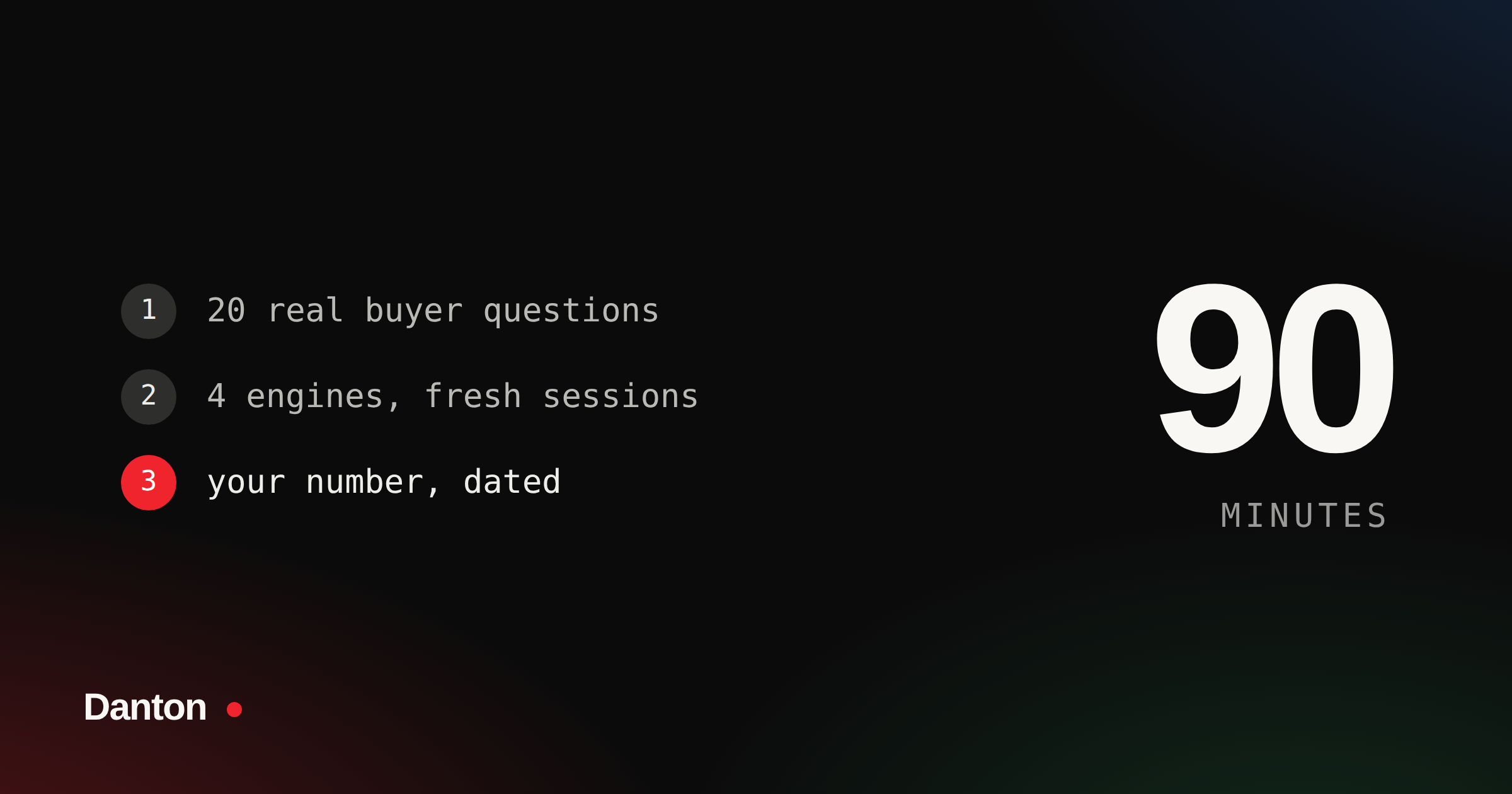
Before you spend a dollar on AI search work, with us or with anyone, you should know your number. Here is the 90-minute version of the baseline we build for clients, simplified to a spreadsheet and an afternoon, with the tradeoffs labeled.
Minutes 0-30: Build a real prompt set
Open a blank sheet. Write twenty questions your buyers actually ask, in their words, not yours. The fastest sources: your last ten first-call notes, your closed-lost reasons, the objections your champions field internally. You want the awkward, specific ones. "Best identity verification for fintech onboarding" beats "top identity companies." Include at least three comparison questions naming your real competitors, because those are the prompts deals hinge on.
Two rules. Do not write prompts you already know you win. And write them down exactly, because this list is now versioned: if you change a question later, note it. An unversioned prompt set produces trends nobody can defend.
Minutes 30-75: Run the panel
Run all twenty prompts across four engines: ChatGPT, Perplexity, Gemini, and Google AI Overviews. Fresh sessions, no custom instructions, no logged-in history steering results. For each answer record three things in your sheet: were you mentioned, were you cited as a source, and what was the sentiment of the mention, positive, neutral, or negative. Note who else appears, every time. Your competitors' totals matter as much as yours.
Resist the urge to re-run a prompt until it says something nicer. That is not measurement. That is therapy.
Minutes 75-90: Score it, with humility
Three numbers fall out. Mention rate: the share of answers naming you at all. Citation share: the share citing you as a source. Competitive position: your totals ranked against each named competitor. Write all three at the top of the sheet with the date.
Now the humility. One run is a snapshot, and engines are probabilistic: the same prompt on the same day can return different answers. Your 90-minute baseline is a photograph of weather, not a climate record, and it should be treated as directional. What makes it valuable is what it almost always reveals: entire question categories where you simply do not exist, competitors the engines love that your team dismisses, and a sentiment problem nobody has said out loud.
What the real version adds
The professional version of this is the same idea with the guesswork removed: a larger versioned prompt set, weekly automated runs, multiple samples per prompt, sentiment scored per answer, share of voice against every competitor, and movement tied to pipeline without overclaiming. That cadence is what turns a snapshot into a defensible number a board will trust. It is the core of our $15,000 diagnostic, and this post is deliberately the free version of it, because a prospect who knows their number is our favorite kind of first call.
Run the 90 minutes. If your number is good, defend it. If it is bad, you now know something your competitors may not know about themselves, and 90 minutes ago it was invisible to you too.
Want the four-minute warm-up first? Take the AI Visibility Self-Audit. Want the real baseline? Book the diagnostic.