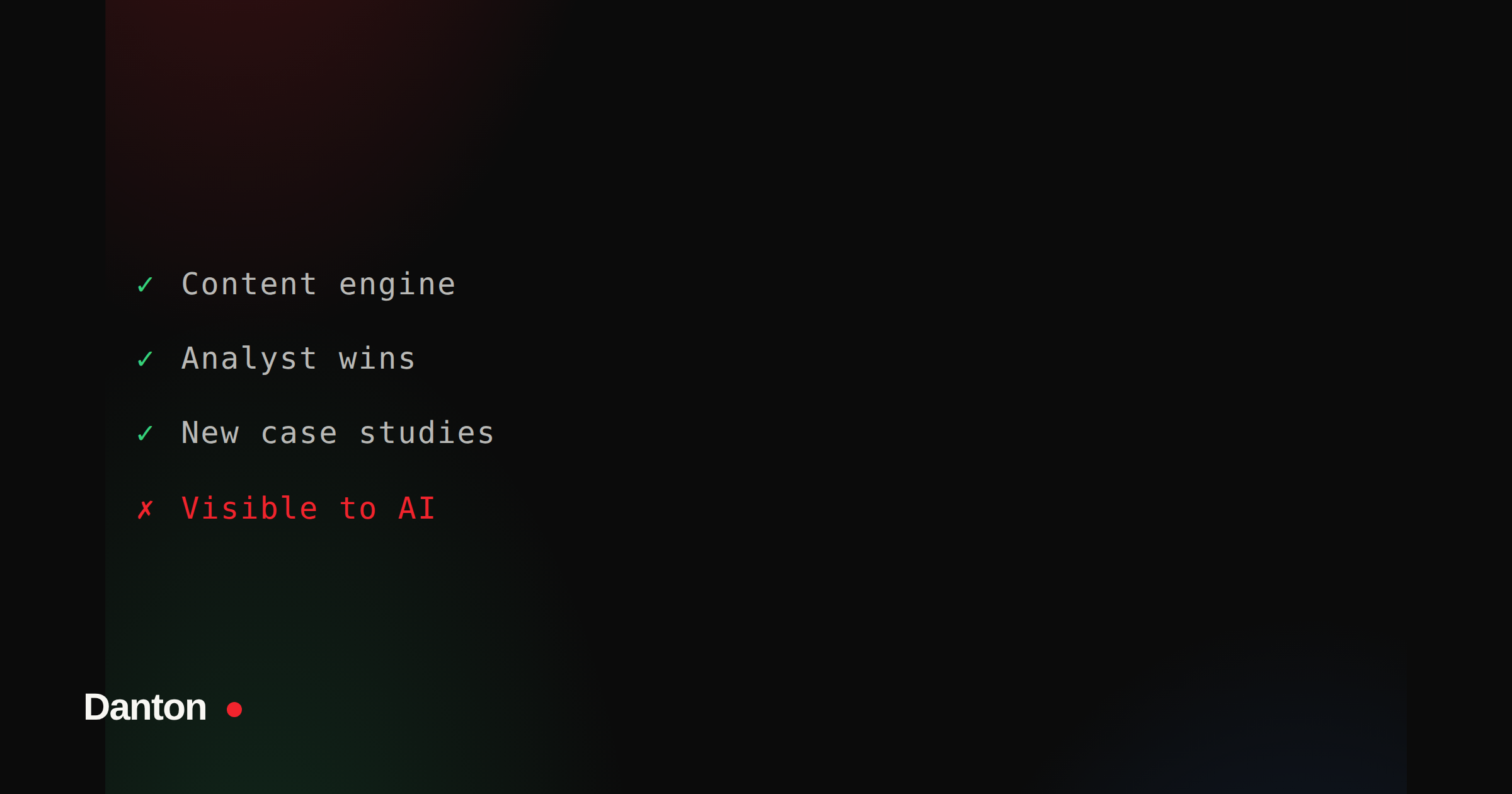
Picture your marketing plan printed on a single page. The flagship research report, gated behind a form that converts beautifully. The blog, shipping steady announcements. A lifecycle program tuned over years. Paid social that makes its numbers. An ABM motion with real air cover on the accounts that matter.
It is a good plan. Genuinely good, built by people who know their craft. Now run one uncomfortable test: ask an answer engine the ten questions your buyers actually ask during evaluation, and count how much of that plan appears in the answers.
The usual result is almost none of it. You are doing a lot of good stuff. AI will not cite any of it.
The Invisible Plan
Walk the page again, this time through the eyes of an engine.
The flagship report, your best thinking, sits behind a gate. Engines cannot read it, so when a buyer asks the question your research answers definitively, they cite a competitor's ungated summary of a shallower study. The gate that captures leads also captures your proof.
The blog publishes news about you: launches, awards, partnerships. Engines are not looking for news about you. They are looking for evidence about the problems buyers ask about, and announcements carry almost none.
Lifecycle email is invisible by design. It persuades one inbox at a time and leaves no public record for a machine to weigh. Paid social is rented attention; when the budget pauses, nothing citable remains. And ABM, the most precise motion you run, still ends with committee members privately asking an engine whether you are the real thing. The engine answers from what it can see, which, per everything above, is very little.
Services firms feel this hardest of all. The most persuasive proof, methodologies, past results, the judgment of senior people, lives in proposals and pitch meetings, delivered one room at a time, where no engine will ever encounter any of it.
Gated. Branded. Ephemeral. Each choice was locally correct, made for good reasons by good operators. Together they produce The Invisible Plan: a program that performs for humans and barely exists for machines, in a market where a growing share of buying decisions routes through the machines first.
The layer on top
Here is what we do not recommend: throwing any of it out. The plan works for the audiences it reaches, and the leads are real. The fix is not a rebuild. It is a layer added on top of the plan you already have, with four components.
Ungated proof pages. The most citable claims from your gated research, your case studies, your methodology, published in the open where an engine can quote them with attribution. The report keeps its gate and keeps converting. The proof stops hiding.
Schema and entity work. Structured data, consistent naming, clean signals about who you are, what you offer, and where you sit in the category. Machines do not extend the benefit of the doubt. Ambiguity reads as absence.
Third-party footprint. Engines trust what others say about you more than what you say about yourself. Substantive reviews, expert commentary, directory presence, contributed analysis: the surface area of independent evidence, built deliberately rather than left to chance.
Evaluation-prompt coverage. Map the actual questions buyers paste into engines, from early category questions to the final two-vendor comparison, and make sure a citable, accurate answer exists for each one. Not keywords. Questions. This mapping is the heart of AI search optimization.
Notice what is missing from that list: a second blog, a new content engine, a duplicate library competing with your own assets. The layer does not replace work you have already paid for. It translates that work into a form machines can read and cite. Nothing on the plan changes. Nothing duplicates.
What it looks like when the layer lands
A national legal firm we work with kept its entire existing program intact while we built this layer over it. It became the most cited firm in its space with the most positive sentiment in its peer set, and it posted its strongest six-month stretch of new client acquisition. The plan did not change. Its visibility did.
That is the shape of the current opportunity. Most of your competitors are likely running invisible plans of their own, which means the citation layer is still a differentiator rather than table stakes. Windows like that do not stay open. The cost of adding the layer is modest next to the plan it makes visible. The cost of skipping it never appears on any report, which is exactly the problem.
So run the audit straight. Take your plan, take your buyers' hardest evaluation questions, and see who the engines cite when those questions are asked. If the answer is you, defend the position. If the answer is someone else, take the good news: the fix does not begin with abandoning your strategy, your team, or your calendar.
Not a new plan. A visible one.
Curious what the engines see when they look at you? Ask about the AI Search Diagnostic, or start the conversation with Danton.