We tell clients that engines are terrible at guessing. This month we proved it on ourselves.
Our firm started life as Danton Ten Six and now operates as Danton GTM. Reasonable rename: the new name says what we do. But we made the change the way most companies do, which is to say we just started using the new name, and when we asked Google's AI Overviews about ourselves, it politely described two different companies. One had our history. The other had our website. Neither had our whole story.
This is what an entity split looks like, and it happens to companies far bigger than us every time a rebrand, a merger, or a product rename ships without a machine-readable paper trail. Buyers asking AI about you get half an answer, or a stale one, and nobody gets an alert when it happens. So here is the playbook we are running on ourselves, published as we run it, results to follow.
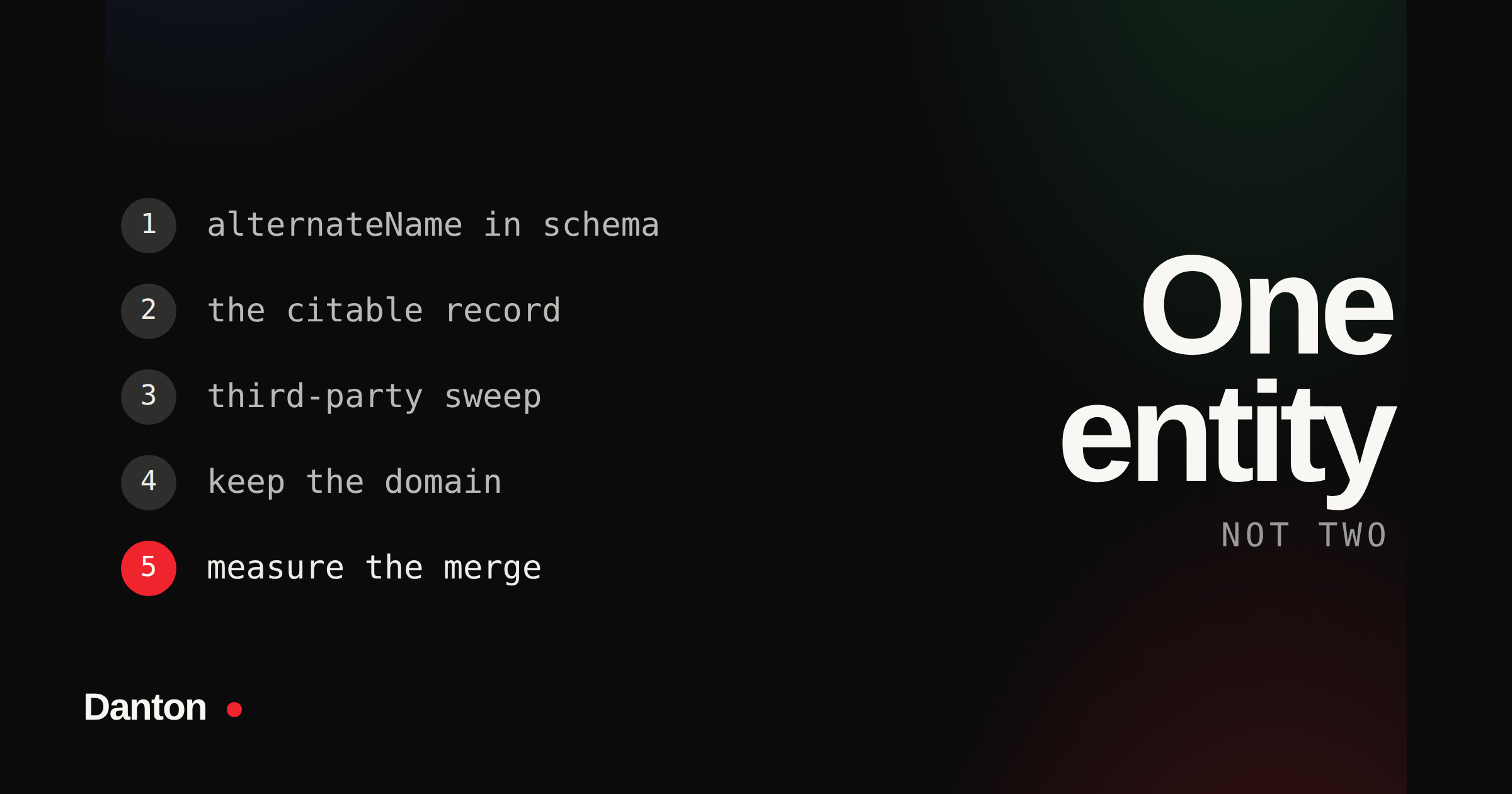
Step 1: Say it in schema
The single highest-leverage move is one line of structured data. Your Organization schema should carry the new name in name and the old name in alternateName, on every page, site-wide. This is the difference between hoping engines infer the merge and telling them outright. Ours went live this week: name, Danton GTM; alternateName, Danton Ten Six.
Step 2: Create the citable record
Engines resolve conflicting information by finding a source that settles it. Give them one: a plainly worded, ungated page that states the facts in extractable sentences. "X and Y are the same company. The canonical name is X." Ours is here, and it exists as much for retrieval systems as for people. When a stale training-data answer needs correcting, this is the page the browsing engines find.
Step 3: Sweep the third parties
Your entity does not live on your site. It lives in the agreement between your site and everything else: review platforms, directories, LinkedIn, your Google Business Profile, even your booking page. Every one of them should carry the same name, and every description field should include the phrase "formerly known as." One afternoon of unglamorous editing. It matters more than any single piece of content you will ship this quarter.
Step 4: Keep the connective tissue
If you can avoid changing your domain in the same season as your name, avoid it. Our domain is dantontensix.com, the old name fossilized in the URL, and that turned out to be an asset: every citation of the old name resolves to the home of the new one. Redirects work, but continuity works better.
Step 5: Measure the merge
We added our own names to our weekly prompt set: the old name, the new name, and the questions a prospect would ask about either. Baseline captured before the fixes shipped. When the split heals, we will know the week it happened, which engine moved first, and which fix preceded the movement. That is the difference between a playbook and a guess, and it is the same discipline we sell.
The uncomfortable part of working on AI search is that your own house is always on display. We found a crack in ours, in public, and the choice was to quietly patch it or to run it as the experiment clients cannot afford to run on themselves. This is us choosing the second thing. Watch this space for the after picture.
Wondering what the engines say about your company? Start with the free self-audit, or bring the question to a 30-minute diagnostic at dantontensix.com/contact.