A hypothesis without a kill line is an opinion with a budget.
Most go-to-market plans are written like manifestos. Confident, ambitious, unfalsifiable. Nowhere in the document is a sentence that says how we would know this is wrong, which is convenient, because then it never is. Channels get defended like territory. Results get narrated. The loudest prior wins the planning meeting, ships in January, and gets quietly rewritten in June.
There is another way to run the whole function, and it is not a new framework. It is a posture borrowed from research: priors, hypotheses, pre-registration, parallel experiments, honest readouts, replication. We call it Evidence-First GTM. Here is the method in full.
Start with priors, not positions
Every team already holds beliefs about what works. The difference between a belief and a prior is structure: a prior is a belief that knows it is a probability. We build priors from your own funnel data, from market evidence, and from pattern recognition earned across 26 years of category shifts. Then we write them down, with our confidence stated plainly next to each one.
Writing priors down does two things. It surfaces disagreement early, while disagreement is still cheap. And it creates something concrete to update later, which matters, because opinions argue and priors update.
Pre-register the test
Before anything launches, every experiment gets three sentences on paper.
What we believe. What result, by what date, would confirm it. What result would kill it.
The third sentence must be written before launch, and it is the discipline most teams skip. Here is why it cannot be skipped. After launch, everyone is invested. The team built the thing, a sponsor approved the spend, and the instinct to protect both is human and overwhelming. Reviewed after the fact, almost any result can be narrated into a soft win: directionally positive, great learnings, needs another quarter. We call this failure The Retroactive Goalpost, and it is how mediocre programs live forever.
A kill line written in advance removes the negotiation. Nobody has to play villain in week eight, because the decision was already made in week zero by calmer people. The kill line is not pessimism. It is respect: for the budget, for the team's time, and for the difference between believing something and knowing it.
Run parallel, decide in four words
A roadmap that tests one idea per quarter learns slowly and bets big. We run experiments as a portfolio instead: several concurrent tests, each sized so no single failure hurts, each carrying its own pre-registered criteria. Parallel beats sequential because the market does not wait for your roadmap to finish.
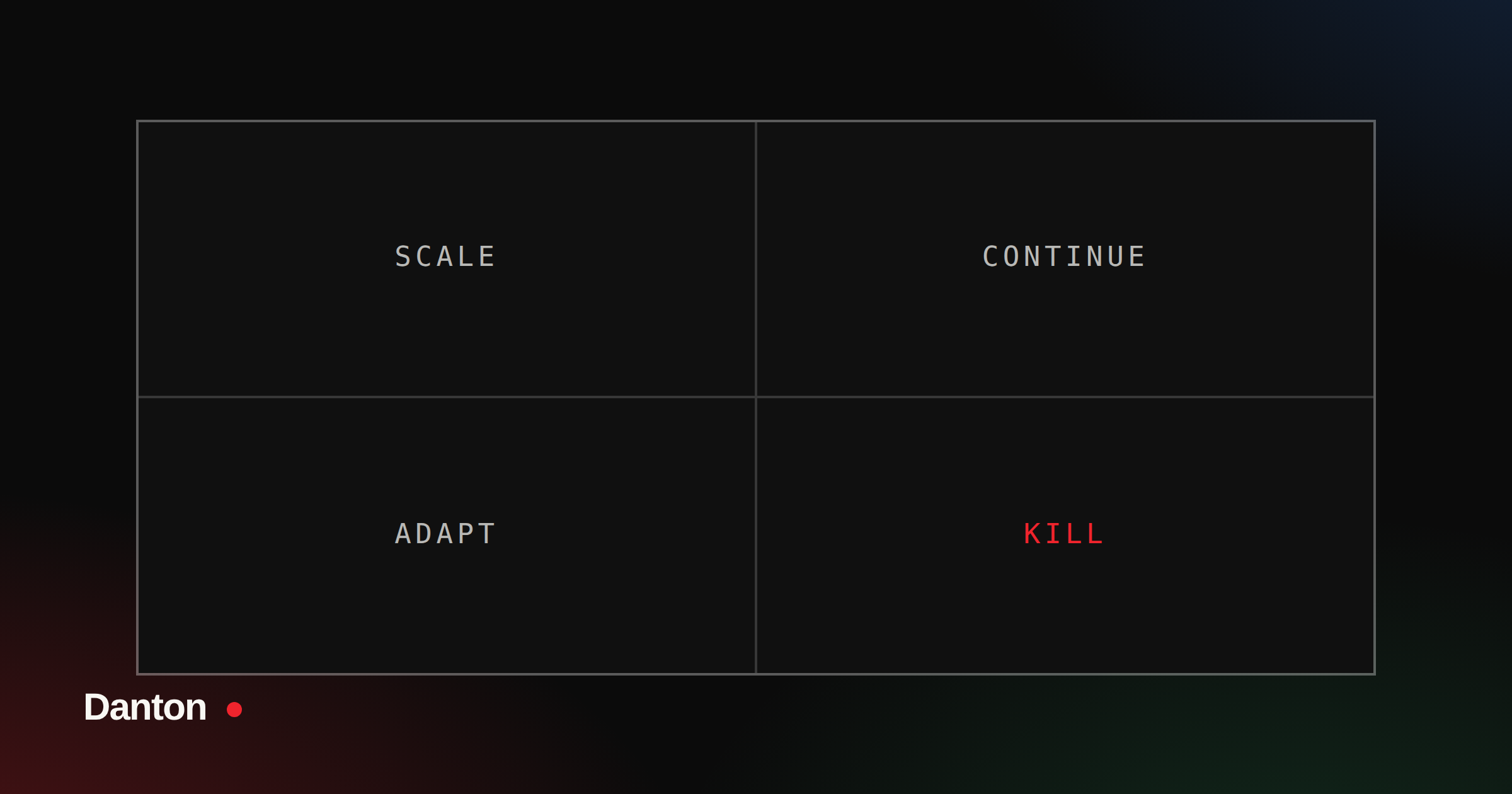
Then, at each checkpoint, every experiment receives exactly one of four decisions: scale, continue, adapt, or kill. Scale what beat its success criteria. Continue what was promised more time. Adapt what shows real signal through the wrong mechanism. Kill what crossed the kill line, and bank the learning without a eulogy. Four words. There is no fifth option called let's discuss offline.
The hard part is belief-updating
None of this is intellectually difficult. The hard part is human. Smart teams resist evidence that threatens hard-won expertise, and they are not wrong to: that expertise was expensive, and a test result that says the playbook stopped working does not land as data. It lands as an audit of someone's judgment.
You do not fix that with a better deck. Arguing data against identity is a losing trade. The fix is to run the test together: co-design the hypothesis with the people whose expertise is on the line, let them set the success criteria, let them hold the pen on the kill line. People rarely update on your evidence. They reliably update on evidence they helped collect. The same result that would have been fought as an attack gets adopted as a finding, because now it is theirs.
Replicate until we are unnecessary
A research program only its director can run is a bottleneck, not a capability. So the final phase is codification. What scaled becomes playbook. What died becomes a documented boundary no one has to rediscover. And the cadence itself, priors, pre-registration, checkpoints, readouts, becomes the way your team plans its go-to-market by default. This is why we work as forward-deployed principals inside client teams rather than advisors beside them: the method has to transfer, or nothing compounds.
CloudResearch described the experience in their public review better than our own site does: "The whole approach was evidence-first: diagnose with real data, form clear hypotheses, define up front what success and failure would look like, and prioritize ruthlessly."
The program looks slower than conviction at first. Then it is faster forever, because you stop relitigating beliefs and start compounding validated ones.
Not replacing your team's judgment. Instrumenting it.
Want to see the method pointed at your newest blind spot first? Ask about the AI Search Diagnostic, or start the conversation with Danton.