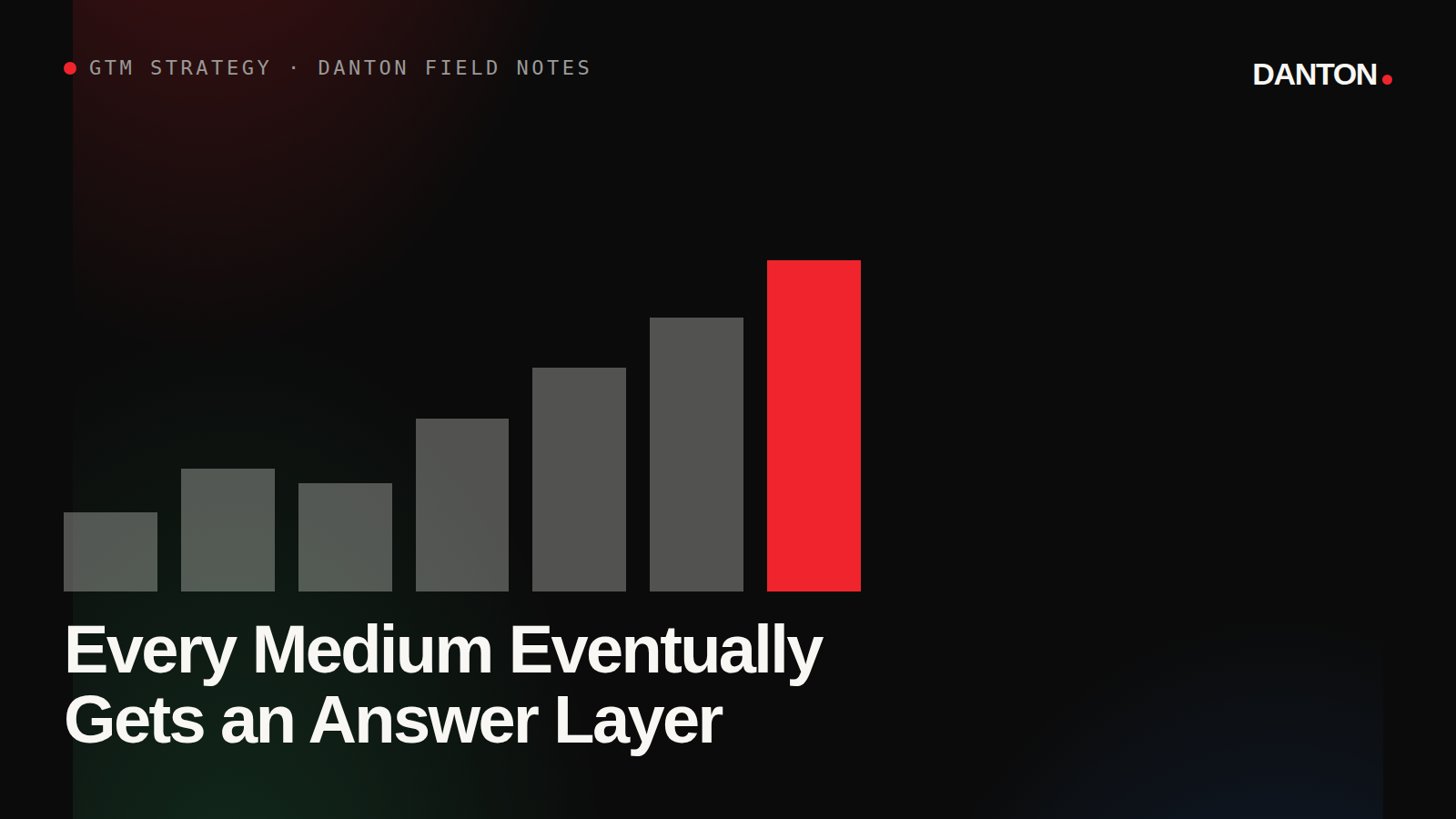
Advertising history is usually told as a parade of formats: the broadsheet, the jingle, the thirty second spot, the banner, the keyword, the feed. Told that way it is trivia. Told another way it is a map. Every medium, in every era, splits into two layers. There is a discovery layer, where buyers find out what exists and who is credible. And there is a persuasion layer, where sellers make their case to people who already know they exist. The persuasion layer is loud, expensive, and wins the awards. The discovery layer is quiet, structural, and decides who gets considered at all.
The discovery layer moves about once a generation. When it moves, fortunes change hands. The pattern has repeated often enough that missing it now should be classified as a decision.
The phone book was the first answer engine
In 1883, the story goes, a printer in Cheyenne, Wyoming ran short of white paper partway through a telephone directory job and finished the run on yellow stock. Reuben Donnelley soon made it a business, and for the next century the Yellow Pages was the most important advertising product in the world that nobody called advertising.
Look at what it actually did. A person with a leaking roof opened a book and asked it, in effect, who fixes roofs near me. The book answered with a structured list. That is an answer engine, paper edition. The persuasion layer lived inside it as the quarter page ad and the bold listing, but the asset that mattered was presence in the category at the moment of need. The slogan said the quiet part out loud: let your fingers do the walking. The walking was discovery, and the book owned it.
Businesses that were in the book got the call. Businesses that were not did not exist. Hold that sentence. It comes back.
Print display: renting attention next to editorial
Newspapers and magazines built the great persuasion layer of the early twentieth century. You rented adjacency to editorial attention and made your case: brand, reason why, a coupon if you were serious about measurement. Claude Hopkins published Scientific Advertising in 1923 and insisted advertising was salesmanship you could test, which made him roughly eighty years early.
Note what print display never did. It did not tell a buyer who the credible options were at the moment the need struck. Discovery still lived in directories, distributors, the salesman's territory, and word of mouth. Print made you preferred. The book made you findable. Different layers, different physics.
Broadcast: interruption perfected
Radio in the 1920s and 30s fused sponsorship with programming. Procter and Gamble sold soap through sponsored daytime serials, and the genre still carries the sponsor's name. Television took the same model and added pictures. Bulova bought the first legal TV spot in 1941, a watch face broadcast before a Brooklyn Dodgers game, and the next four decades belonged to the thirty second interruption.
Broadcast was the persuasion layer at maximum amplitude. It built preference at a scale print never touched. And through all of it, the discovery layer barely moved. The television taught you to prefer Tide. The book still told you who could fix the washing machine. Companies that understood they were running two separate systems, mass preference on one side and directory presence on the other, did fine in both.
Search: the discovery layer finally moves
Then it moved. GoTo.com began auctioning placement against typed queries in 1998. Google AdWords arrived in 2000 and, within a few years, made the auction the market. For the first time, persuasion could be purchased inside the discovery moment itself. The question and the pitch shared a screen.
The Yellow Pages did not decline because people stopped having leaking roofs. It declined because the answering moved, while the directories kept selling bold listings for a book fewer fingers walked through. Meanwhile a generation of companies got rich on one observation: be present, paid or organic, where the questions now went. The organic half of that observation became SEO, which was never really about tricks. It was about being the best available answer in a ranked list.
We were in the room for that one. Danton's search and GTM practice is 26 years old, dating to the first AdWords auctions, and the durable lesson from those years was not about keywords or bid strategy. It was simpler. Watch the questions. The questions tell you where discovery lives this decade.
Social feeds: arbitrage, not answers
Social advertising in the 2010s was attention arbitrage: enormous audiences, inventory priced below its worth for a while, targeting that let you create demand instead of waiting for it. For consumer products, feeds took a genuine share of discovery. Plenty of things are now found mid-scroll. For considered B2B purchases, feeds built awareness while search kept the discovery franchise, because a feed answers no questions. Nobody diligences a vendor in a scroll. The two layer structure held.
Synthesis: discovery consolidates into one surface
Which brings us to now. Ask an assistant which vendors can do a job, whether a platform is credible, who actually leads a category, and you get one composed verdict. Not ten links to evaluate. Not a directory to walk through. A paragraph.
Understand what that is in the historical frame. The discovery layer is consolidating into a single surface, and this time the surface does the buyer's reading for them. The ranked list at least showed you the contestants. The synthesized answer shows you the conclusion. And, for now, the surface does not sell placement. You cannot buy your way in. You can only be the material the verdict is built from, a sentence the Yellow Pages sales force would have found baffling and your board should not.
Businesses that are in the answer get the call. Businesses that are not do not exist. Told you it would come back.
What carried over, and what died
Every transition killed formats and spared fundamentals. The jingle died. The bold listing died. The exact match bidding trick died. Three things survived every single move.
Proof survived. Hopkins' reason why copy became the testimonial, became the case study, became the citable, sourced claim. Every era's discovery layer has favored sellers who could evidence what they asserted.
Distinctiveness survived. A name the medium could tell apart from its rivals mattered in a directory column, on a shelf, on a results page, and matters now to a model deciding whether you are a distinct entity worth citing or a smear of category language.
Availability in the buyer's moment survived. In the book, on the air, on page one, in the answer. The venue changes. The requirement to be present when the question is asked has never once lapsed.
Formats die. Fundamentals transfer. The fatal mistake, every time, is defending a format while the discovery layer walks away from it.
The companies that lost these transitions were rarely lazy and almost never stupid. They were disciplined about the wrong layer. They perfected the spot while the questions moved to the search box, and they are perfecting the search ad now while the questions move into assistants. Discipline aimed at the persuasion layer is a fine thing. It is no substitute for noticing where the questions went.
If you suspect the questions in your category have already started to move, we are glad to compare notes.